Wednesday, January 2, 2019

Tarot Deck Interview Spread


The other week I got my first tarot deck in the mail -- the Golden Thread Tarot. It's extremely beautiful and if you're not familiar I recommend checking out the creator's website and free app here.

Sitting down with the deck for a few calm shuffles and some examination of the cards, I decided to do an interview with my new deck to see what's in store for my 'relationship' with the cards.

Tell me about yourself. What is your most important characteristic?
Queen of Pentacles. 

A nurturing and practical figure. The Queen balances work, life, and love to keep her home flourishing and secure. The Queen is compassionate, but also down to earth and a staunch realist. I believe that this means the deck is ready to help me sort out the worldly concerns of my life (financial, skills, the home), but isn't afraid to force me out of my own head and demand I stop dreaming and start doing.

What are your strengths as a deck?
Page of Pentacles

I see this as a card of developing skills, learning, beginning the journey to a greater understanding of the world, your place in it, and how you can use your skills practically. Very close to the Queen, perhaps they see me in this role, teaching me to understand my own goals and manifesting them.

What are your limits as a deck?
7 of Swords

A turning point. So this deck is a liar, or at the very least, sneaky. I feel as though this means that we're in for challenging readings, a lot of clarification that won't be found, perhaps something misleading here and there. With the cards strengths it seems to me that this deck is much more grounded than me, and with this weakness it could indicate that we may struggle to be honest with each other or understand one another. In addition, like the Queen, I believe this card indicates that the deck feels independent from me.

What are you here to teach me?
8 of Pentacles

Mastery, routine, skill. I'm so often locked in my own head and this deck is here to drag me down to earth and make me consider reality as it lays in front of me.

How can I best learn and collaborate with you?
Death

Dramatic. But it's telling me to not be afraid of change and to accept it readily. Hard lessons are inbound and in order to strive for my goals I need to be prepared for change, transformation. Perhaps the deck (who I'm already reading as a stern figure) is telling me that the changes have come already and I need to let go of my head-in-the-clouds tendencies and face the music.

What is the potential outcome of our working relationship?
The Tower

Big changes, challenging ones, and not ones I want to hear or ones I should expect. Even if I'm prepared for the changes, the world is bigger than I am and nothing can prepare me for everything. Even the deck seems to have a sly role in this, with a bit of deceipt. But I appreciate this little bit of honesty and won't let it scare me.


So what did I get from this?

I see a figure that is, in many ways, the opposite of me. Pragmatic, down-to-earth, maybe even a bit dry. The deck told me at the start that it is compassionate, nurturing, prepared to help and build something beautiful. But then it told me in so many ways that it will not be easy and it will demand a lot of me.

I see a stern figure that isn't going to put up with my bullshit or spoon-feed me easy answers. I like that. I felt a bit of a turn in my gut with the last two cards (who wouldn't?) but I see them now as a way of telling me that if I'm going to get anything done with the deck or with my life, I need to be serious about it, and be ready for whatever comes. I respect that.

Wednesday, September 19, 2018

The Master of Ravens

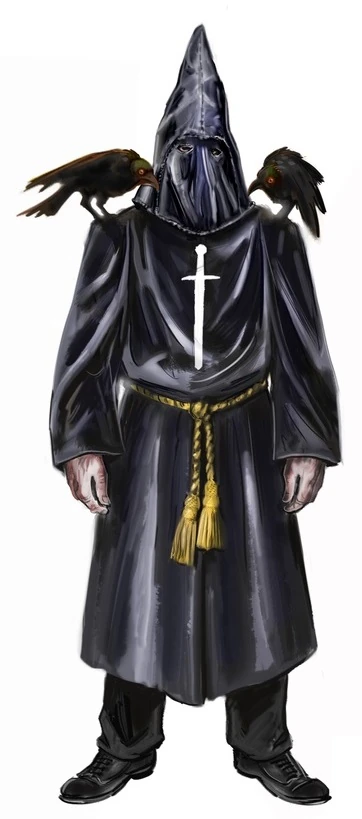
This idea came to me when I remembered how cool those evil racist dudes from Bioshock Infinite looked. You could probably have a couple nights of D&D with this concept.

A druid in the nearby wood has become a master of birds. The crows, ravens, and magpies alike are drawn to them. Multiple hunters have been found with their eyes pecked out, their throats torn open. Most mysteriously, though, are those who return complaining of being surrounded by crows that nobody can see.

The Master of Ravens is a pitiful druid broken off from their tribe. The Master encountered a strange group of corvids in the recent months, and has formed a strange sort of bond with them. The bond is honest and genuine, and the ravens are not evil by nature. Perhaps not even the druid truly is.

They carry a huge birdcage filled with up to 20 ravens at any given time. The cage rattles and shifts on their hunched back.

If confronted, The Master opens the cage doors and commands the ravens to fly not at, but past their enemies.

If a raven disappears past your peripheral vision (as in, can be seen out of the corner of your eye but then leaves your line of sight), it can enter your vision, vanishing from the Waking World and reappearing inside you. Not in your brain, or your eyeballs, or anything crude like that. The devilish little bastards find their way into your perception itself.

Just one of them is distracting, one little bird fluttering in front of you yet never flinching at your frantic waving around. As more enter, it becomes harder and harder to focus on what's right in front of you. Eventually you're blinded and maddened by crows that aren't even there.


You could implement a -1 on all rolls for each raven in their vision, until the player becomes blind and then your rulings would just take over. Most importantly, explain nothing to the players. Only affected players will see the birds. Everyone else will simply see them disappear, and nothing more. This could frustrate the affected player; let them figure it out.

The only way to get your sight back is if the crows get hungry and flit back to the Waking World to have some birdseed. If you don't have it ready for them when they leave they will be at least a little pissed with you, and crows are smart enough to remember faces.

The Master is convinced, to the point of delusion, that the ravens chose them for a reason.

The Master has forgotten that nature does not innately bend to man, forgotten that their purpose is to be a part of nature, not command it.

If you befriended the ravens you may have a chance. Otherwise, get used to your wizard being blinded, panicked, and killed.

Saturday, September 8, 2018

Lies Your Players Will Hear About Orcs

Orcs as savage brutes are cool, whatever. I think there's a dimension of complexity to that portrayal that goes unnoticed. They’re the classical fear of mankind... that we're just some decent architecture and a few fancy machines from being violent and superstitious boogeymen that expand our territory over everything and reject outsiders. The orcs barbarism makes them effective as stormtroopers, and perhaps a sort of "how different are you, really?" angle if you want to take your game in that direction. If you think your players would like that angle, go for it.


A common argument against this portrayal is that it closely resembles imperial propaganda about Africans, Vietnamese, Muslims, etc. I would say that if your players aren't already evil racist fucks, your D&D game won't change their mind, but I digress.

If you're looking for a way to put your orcs in a more classically Romantic setting, here are some lies about orcs your players will hear, and may have to unlearn. But perhaps not before blood is on their hands, and they must seek redemption. Now there's a goddamn campaign.

So what is an orc?


Orcs did not name themselves that, they do not actually have a name for themselves. Or they didn't, until they were assigned the orc name.

“Orc” is an ugly word for an ugly creature. Or at least, Castles and Temples insist that the orc is ugly. What the orc looks like changes depending on the duchy, the island, or the forest you're in. And anybody who resembles an orc is ugly. It's the clearest possible way of defining attractiveness.

While humans are compared to primates -- the intelligent and crafty mammals, and elves are compared to something flowery or odd in nature -- something you can love but never resemble, the orc is always compared to the gruntiest, nastiest, toughest, and dumbest animals on the farm. Pigs and cows. Anything fleshy, big, dirty, or coarse-haired. Comparing an orc to a pig is helpful for the Castles and Temples. It makes it easier when they try to justify an orcs enslavement or slaughter.

An orc may be beautiful. But you probably shouldn’t tell anybody that you think an orc is beautiful. “Orcs do not have intercourse,” says the old bishop, scrunching his nose at the idea and handing you your payment -- 10 gold for 10 dead orcs. “Are they not born from mud and manure?”

(So orcs become a possibility for player romance, the forbidden love of something hated and scorned by society.)

An elf is naturally magical. An orc would never know magic. It's not like them. They are snorting, disinterested in any religion not defined by barbarism or sacrifice. They celebrate under the stars, dancing around fires, nothing like the respectable worship in temples, seated in pews. If you call an orc out on their religious hypocrisy, they would kill you. The temples in the city would at least put you on trial first.

When the adventuring party rolls into town, the Castles and Temples send them to slaughter orcs. Slaughter the pigs, your reward will come. The Castles and Temples know that the lowlives who search for treasure in the grim and abandoned curios around the wilderness will eventually turn their gaze on them. All adventurers get ideas eventually. Better to send them to the slaughter, and make use of them before they turn on you. Perhaps they will conveniently never return.

The adventurers may become the Castles and Temples, in time. They may never question the lies, and leave orc children without parents. They may never question why the orcs don’t attack first, retreat early, and never let a fallen comrade remain in the dirt. They may never question why there are no castles, kings, taxation, or disease in an orc's village, or why orcs raid caravans for grain and tools but never gold.

But they may recognize this convenient lie for what it is, and marry an orc, live as an orc, defend an orc in court.


If you’re like me, cynical and romantic all at once, you will find both possibilities are satisfying to see play out. You either get a pack of murder-machines, the pawns of greater powers, or Romantic heroes that reject the in-place power structures and change the lives of a precious few. 

And, most importantly, your players will have fun either way. 

x